Were Dragons Real?
While it may seem like they are a myth, there’s a lot of evidence to suggest they existed. The primary evidence for this is the fact that almost every culture on earth has some sort of depiction of a dragon from the aboriginal of Australia to the Native American tribes of the United States. Dragons tend to have different interpretations across cultures and are often depicted as a combination of the local animals. While it is possible that dragons existed (there’s even a beetle alive today that can produce fire through chemicals), if they did exist they most likely existed with only two legs and two wings as they are depicted in Game of Thrones. Yet when dragons are depicted in various cultures they tend to be a combination of various distinct animals. Why is this?
Evolutionist Theory on Dragons
Evolutionist theorizes that dragons are simply a combination of the greatest fears of our primate ancestors more specifically a combination of a snake, big cat (lion or leopard), eagle, and fire. The animal most closely associated with dragons are snakes one of the greatest enemies of man. Snakes are the third deadliest animals on earth with the only two animals that kill more humans being humans themselves and mosquitos (who only kill people indirectly by spreading diseases). There’s also a theory that snakes are the reason humans have the eyesight we have because we’ve adapted over time to have better eyesight for seeing snakes. Human eyesight is considered some of the best in the world especially when compared to the eyesight of other mammals. Studies done on primates that have to live with snakes confirm that they have better eyesight than primates who don’t.
Interestingly in Genesis, Satan who takes the form of the serpent is the literal reason humans started to see. After the serpent convinced Eve to take a bite of the forbidden fruit she could see that she’s naked, seeing her vulnerability. In Genesis 3:15 KJV God tells the serpent (Satan), “And I will put enmity between thee and the woman, and between thy seed and her seed; it shall bruise thy head, and thou shalt bruise his heel.” So here, God reveals that there will be an intense rivalry between man and snakes, and this can certainly be seen by the number of people that die from snakes and the evidence that they’re responsible for our amazing eyesight. There’s also a more symbolic meaning behind this I will get to later.
Dragons in The Old Testament
The word used to refer to dragons in the Old Testament is the Hebrew word Tannin which can also be translated as dragon, serpent, or sea monster. This however, could just as easily be used to refer to dinosaurs because the word dinosaur didn’t come about until the 1800s and before then all large reptiles were called dragons. One creature identified as a tannin is the Leviathan. This creature is mentioned by God in the book of Job saying how he created the Leviathan which is a massive creature with scales that lives in the sea. It even states that sparks of fire come out of its mouth and smoke out of its nose.
In contrast to the Old Testament, dragons always refer to satan in the New Testament. It’s said that the bruising of the serpent’s head along with the biting of the seed of the woman’s heel in Genesis, is the playing out of the crucifixion of Jesus when Satan was ultimately defeated. Satan is also depicted in Revelations, as a red dragon with seven heads, ten horns, and ten crowns who is attempting to devour a baby (Jesus) as he is being born.
Europe

Dragons in Europe are often seen with four legs and wings. In stories, they’re usually depicted as living in caves and guarding mass hordes of treasure (as done in The Hobbit by J.R.R. Tolkien). One of the most famous stories involving dragons in Europe is the story of Saint George. Saint George was a real-life member of the Praetorian guard for Emperor Diocletian during the Roman Empire. Today he is the patron saint of England, Ethiopia, Georgia, and Catalonia. The story goes that Saint George confronted a terrible dragon that was terrorizing a city in Libya and saved the King’s daughter as a result. When dragons are considered good in Europe they are thought of to have wisdom much like how in Asia they are usually seen as benevolent and keepers of great wisdom. Legends say the Welsh took up the red dragon as their sigil after the Romans left Britain to symbolize their power.
Asia
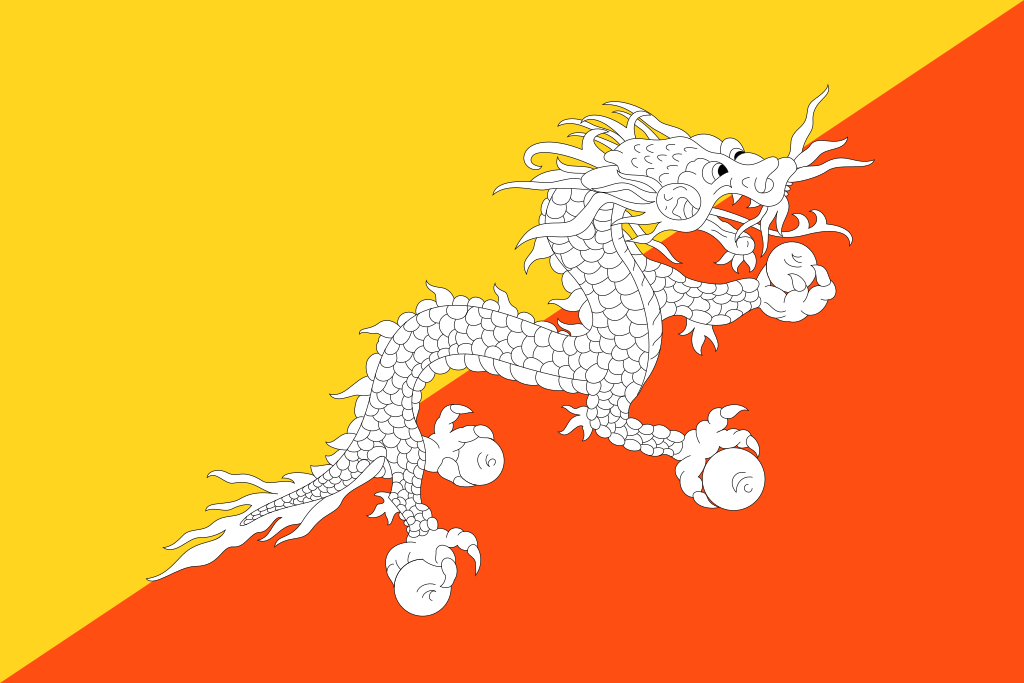
Dragons in Asia are drastically different from dragons in Europe. For Asian dragons they have the head of a camel (Chameleon in south east Asia and Japan), scales of a carp, antlers of a stag, eyes of a rabbit, ears of a bull, neck of a snake, belly of a clam, paws of a tiger, and claws of an eagle. While in Europe dragons are almost always seen as malevolent they aren’t seen that way in Asia. In China, they are seen as good luck and as sources of wisdom and in Vietnamese mythology, the Vietnamese people are descended from a great dragon. Dragons are also more associated with water and wisdom than fire and destruction. One dragon in Chinese mythology is very similar to the dragons of Europe called Fuzanglong. Like European dragons, Fuzanglong is said to guard treasure and is associated with fire. In Bhutan, their national symbol is the thunder dragon Druk who Giles’s jewels symbolizing the wealth of the nation.
Polynesia

In Polynesian mythology more specifically the mythology of Hawai’i are the Mo’o. Mo’o are shapeshifting dragons that usually take the form of geckos, beautiful women, or oceanic dragons. The idea that dragons are feminine and live oceans is a very old concept. One of the first dragons ever depicted was Tiamat, a female dragon who was said to be the embodiment of chaos who lived in the ocean. Mo’o are said to guard freshwater pools on the Hawaiian islands. They are said to be very powerful and like in many Asian depictions of dragons can control weather. The nature of Mo’o is dependent mostly on how people who encounter them treat them. If you disrespect them they will tear you apart, but if you are good to them then you can gain plentiful harvests. This ultimately speaks to the one of the most important philosophical ideas of the Hawaiian people which is to respect nature and the land. This idea is what allowed Polynesians to survive on the islands they inhabited for centuries without outside influence.
South America

The dragon of Incan mythology was known as the Amaru. It’s depicted as a two-headed dragon with one head being that of a bird and the other being that of a cat (Jaguar or Puma) or sometimes a llama, the body of a serpent, and the wings of a condor. The Amaru is supposed to be the bridge between heaven and earth, it takes the form of the rainbow during the day and the Milky Way at night. The serpent represents the watery underworld, the puma/jaguar or llama represents the earth, and the condor represents the sky. Like the Mo’o of Hawai’i, it’s said to dwell near bodies of freshwater and has the ability to control the weather. In addition, like the Mo’o they are a representation of Mother Nature.
Conclusion
One major interpretation that can be gathered from all this is that dragons can represent nature. As depicted by the Mo’o if nature is respected, then great rewards can be yielded. The Amuru shows how nature is unavoidable. We may try controlling it and reducing it in this world but it ultimately cannot be escaped. Like the Amuru, it exists in the depths, on the lands, and in the skies. It says in Genesis that man is meant to take care of the earth and respect it but in a lot of ways that have not been done. A prime example of this are the fires that occurred in California that I witnessed and had friends lose their homes from. They occurred because the forests were taken care of. The Native Americans for centuries took care of the forests by having controlled burnings and cut down specific trees. Since then forests have been allowed to go wild causing there to be more plants that are drier because they’re competing for moisture making them more susceptible to fires, and entire species of trees have nearly gone extinct because the forests haven’t been properly maintained to allow them to prosper. Because of this disrespect for the dragon that is nature we got burned. This is just one example the oceans are a prime example as well. There is t a single oceanic fish in the world that doesn’t have traces of plastic in it. Troll fishing not only decimates fish populations (of fish intending to be caught or not) but also destroys coral reefs which are essential to entire ecosystems. A fundamental belief in Andean and Polynesian cultures is a belief in the respect and importance of nature and this can be seen by their depiction of dragons that represent Mother Nature. This is a belief that should be once again remembered throughout the world.
The other main interpretation to get from how dragons are represented in Europe and Asia is that dragons represent chaos and the unknown. Despite this though they are also the key to success. This makes sense because the only way you succeed in this world is not by running from chaos, but confronting it. It makes a lot of sense that confronting something that represents the unknown and chaos is how you gain wisdom. Of course, you underestimate the chaos. In A Dance of Dragons by George R.R. Martin, when Quentyn Martell attempted to control a dragon for power he turned his back on a different dragon and as a result, was roasted alive. The unknown and chaos is dangerous and should be feared. But it should be confronted all the same because that’s how we ultimately grow as people and how we gain what we’re seeking whether it’s a monetary success as depicted in Europe or wisdom as depicted in Asia. If you spend your entire life running away from conflict and the unknown you’ll remain stagnant and most likely won’t achieve very much in life. My aunt once advised me that you should never be the smartest person in the room. You should always continue to find out what you don’t know.

 Basic Humanity